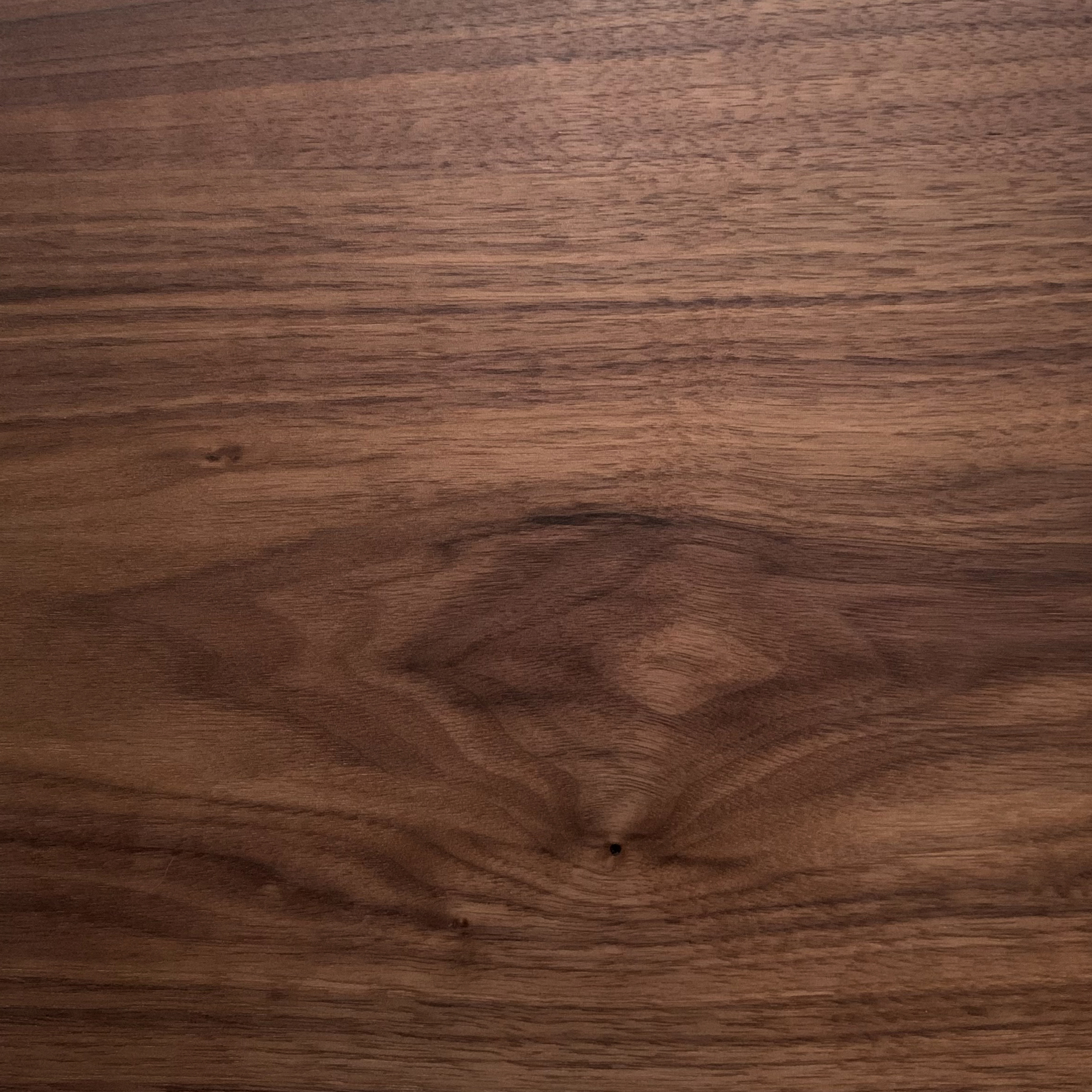
American Walnut
Noble Dark Tone and Flowing Elegance
American Walnut, often referred to as Black Walnut, is one of the most exclusive and sought-after hardwoods in premium interior design. With its warm, deep brown coloration and elegant grain, it lends an aura of understated luxury and timeless durability to any space.
Aesthetics & Character
High-End Design Integration
In minimalist and luxurious interior concepts, American Walnut often acts as a "provider of warmth." It forms a stunning, organic contrast to cool materials such as exposed concrete, natural stone, real metal, or dark, museum-like obsidian tones. Whether as a large-scale wall cladding accentuated by subtle lighting, or as a statement piece in the room – this wood radiates a deep, authentic value that is immediately palpable.
Spatial Impact
Creates a mysterious, museum-like aura and intimate warmth. Perfectly suited for sculptural contrast walls, executive boardrooms, and boutique hotels.
Sustainability & Origin
Responsibly harvested fine hardwood from certified North American regions, licensed according to the highest environmental B2B standards.
Technical Properties
Natural Acoustic Performance
American Walnut possesses exceptional acoustic damping and structural properties. The fine-pore structure minimizes unwanted reverberation. Combined with our sculptural wood panels, this premium timber creates a top-tier acoustic atmosphere with a warm, deep sonic character.
Surface Finishing & Care
To perfectly accentuate the deep chocolate-brown hues and luxurious patina of Black Walnut, the surface is meticulously hand-sanded and sealed with organic oils. This gives the wood an elegant, silky-matte sheen. Maintenance: Use only a dry microfibre cloth or a slightly damp wipe.
Comprehensive Material Science & Specifications
1. Material Overview & Botanical Character
American Walnut (Juglans nigra) is the ultimate premium hardwood for exclusive living spaces. With its dark, chocolate-brown color and silky finish, this exquisite timber exudes pure elegance and serenity. A Brinell hardness of approx. 26 N/mm² makes it a stable hardwood, perfect for fine geometric milling. An exclusive wine rack or 3D wall panel made from walnut is a visual statement of luxury. At DEKOSTYL, every walnut piece is inspected.
2. Origin & Sustainable Forestry
Our American Walnut is sourced from sustainably managed hardwood forests in North America. After harvesting, the timber is shipped under controlled conditions to Europe, where it is crafted in local workshops. The sustainability of the forests is certified by international standards. Controlled kiln drying ensures that the solid wood remains free of internal cracks and resists warping.
3. Aesthetics & Grain Pattern Character
The visuals of walnut feature a wavy grain structure and color variations from light brown sapwood to deep violet-black heartwood. This grain pattern makes every panel a natural masterpiece. Through manual sanding and oiling with open-pore hardwax oils, the surface gains a matte depth that diffuses light, spreading a comfortable warmth throughout the space.
4. Aging Process & Natural Patina
Unlike many light woods, American Walnut tends to lighten slightly over the years under exposure to sunlight, developing a warm amber-like tone. This effect is a natural characteristic of genuine wood and can be slowed down using UV-protective oils. The maturing patina highlights the quality and history of the material, giving the wall design a living aura.
5. Applications in High-End Architecture
Walnut is the perfect material for feature walls in luxury homes, executive suites, or boutique lounges. As an official distributor, we provide bespoke design solutions. Walnut panels are frequently deployed as acoustic panels in home cinemas or boardrooms to combine quiet soundscapes with high-end visuals. It is also the most sought-after material for OWN Studio wine racks.
6. Comparison with Other Fine Hardwoods
Compared to oak, American Walnut is softer and more elastic, giving it a silkier feel. Its dark coloring distinguishes it from oak and ash, making it the top choice for contrasting, high-impact interior concepts. While ash represents Scandinavian brightness, walnut stands for warm, international luxury and a timeless investment.
7. Maintenance, Protection & Value Preservation
Caring for walnut wood requires minimal effort. A dry, soft dusting cloth is sufficient for daily cleaning. Liquid spills should be wiped away immediately with a slightly damp cloth. Avoid microfibre cloths with abrasive qualities or chemical solvents to protect the oil finish. Every few years, treating the wood with a premium maintenance oil is recommended to preserve its silky sheen.
8. Frequently Asked Questions (FAQs)
Q: Why is American Walnut more expensive than oak? A: American Walnut grows slower, is rarer, and must be imported. The demand is exceptionally high because its deep dark color and exclusive grain make it one of the most premium woods globally. Q: Does the wood fade over time? A: Under strong sunlight, walnut wood lightens slightly over the years and becomes more golden-brown. This is a natural maturing process. We recommend protecting the panels from direct, intense UV exposure. Q: Does walnut match modern, light furniture? A: Yes, beautifully. Dark walnut creates a stunning contrast with light fabrics, raw concrete, or minimalist white walls, instantly adding warmth and character to the living space.
Material Specification American Walnut (Juglans nigra)
American Walnut, botanically Juglans nigra, embodies the absolute peak of exclusive interior design. With its deep, chocolate-brown base coloration and expressive, dark violet streaks, this fine wood radiates incomparable elegance and cosmopolitan calm. The raw density is around 0.58 g/cm³, coupled with a Brinell hardness of approx. 26 N/mm². Walnut wood is slightly softer and more elastic than oak, but offers outstanding dimensional stability. This property makes it the ideal material for high-precision, sculptural wine objects from OWN Studio and intricately milled 3D panels.
The Swelling and Shrinking Behavior of Walnut
American Walnut has an exceptionally low shrinkage. The differential shrinkage coefficients are only approx. 0.21% tangentially and approx. 0.13% radially per 1% change in moisture. Walnut therefore "works" significantly less than most other hardwoods. This inertia towards fluctuations in air humidity prevents cracking and warping in the finished design object. Despite these positive properties, the wood is conditioned in our drying kilns for weeks to set a homogeneous core moisture content of 8%. This ensures the perfect fit of the individual elements and guarantees that the bottle supports of the wine sculptures remain accurate to the millimeter over decades.
Moisture Behavior and Biological Finishing
Walnut wood has good natural durability, but is more sensitive to direct moisture than oak. Walnut should be avoided in splash water areas of bathrooms. In normal interiors, however, the wood proves to be extremely stable. To perfectly show off the velvety feel and fascinating color depth of walnut, we rely on an elaborate finish with biological natural oils. These oils penetrate deep into the wood and emphasize the noble structure (the so-called "firing" of the wood) without applying an artificial gloss film. The treated surface becomes silky-matte and remains tactile.
UV Sensitivity and Aging Process
An important physical characteristic of American Walnut is its reaction to ultraviolet light. Under strong light influence, walnut tends to lighten slightly over the years and take on a warm, honey-colored amber tone. To slow down this natural aging process, the panels and wine sculptures we curate are treated with oils that contain a light, biological UV protection. Nevertheless, we recommend not exposing walnut objects to permanent, extreme direct sunlight in order to preserve the deep, dark pigmentation as long as possible.
Integration into High-End Cabinetry and Aesthetics
The demanding processing of American walnut requires years of experience in dealing with this precious wood. Due to its fine and uniform fiber structure, the wood hardly tends to splinter during milling. This allows us to realize extremely fine 3D reliefs with razor-sharp edges and smooth transitions. In the wine presentation systems of OWN Studio, the mechanical precision of the walnut is used to create stable plug connections and invisible screw joints. Walnut stands like no other wood for timeless, modern luxury and, in combination with modern elements such as brushed stainless steel, exposed concrete, and sophisticated lighting concepts, forms a harmonious unity that gives rooms a noble aura.
Care Instructions for Valuable Walnut Objects
The care of American walnut differs slightly from other woods, as its dark coloration and silky texture can show dust and fingerprints more clearly. For daily cleaning, a dry, antistatic microfiber cloth is particularly suitable. For heavier soilings, a damp leather cloth can be used to absorb excess moisture immediately. To preserve the intense, chocolate-brown color and noble sheen for years to come, the wood should be treated once a year with a very thin layer of high-quality walnut care oil. This nourishes the wood, protects it from drying out, and refreshes the characteristic, noble grain, making the wine sculptures and panels shine as they did on the first day.
Haptic Sampling
Order a hand sample of American Walnut and convince yourself of the dark elegance, silk-smooth finish, and premium aura of this exquisite hardwood.